Page 54 Figure it out
Suppose you are using the number system that uses sticks to represent numbers, as in Method 1. Without using either the number names or the numerals of the Hindu number system, give a method for adding, subtracting, multiplying and dividing two numbers or two collections of sticks.
Solution :
Here are the stick-based methods for the four basic arithmetic operations.
Addition (Joining)
Take the first collection of sticks (A) and the second collection of sticks (B).
Example: Collection A ($|||$) and Collection B ($||$)
Move all the sticks from collection A and all the sticks from collection B to form a new, single collection (C).
Collection C is the sum of A and B.
Result: Collection C ($|||||$)
Subtraction (Taking Away)
To find the difference between two collections (A - B), you remove a sub-collection (B) from the larger collection (A).
Example: Collection A ($||||||$) and Collection B ($|||$)
From the main collection A, remove and set aside a group of sticks that exactly matches the size of collection B.
This operation is only possible if A is the same size as or larger than B.
Result: Remaining sticks ($|||$)
Multiplication (Repeated Joining)
To find the product of two collections (A $\times$ B), you join collection A (the multiplicand) a number of times equal to the size of collection B (the multiplier).
Example: Collection A ($|||$) and Collection B ($||$).
Create a new large collection by repeatedly placing copies of collection A. The number of copies of A you place must be equal to the number of sticks in collection B.
The combined final collection is the product.
Result: Final Collection ($||||||$)
Division (Repeated Grouping / Dealing Out)
To find the quotient of two collections (A $\div$ B), you distribute the sticks of A into groups, where each group must be exactly the size of B.
Example: Main Collection A ($||||||$) and Divisor Collection B ($||$).
Repeatedly remove a sub-collection from A that exactly matches the size of B.
For each sub-collection successfully removed, place one stick into a new "Quotient Collection" (Q).
Result:
The total number of sticks in the Quotient Collection (Q) is the quotient.
Any sticks remaining in the original collection A (too few to form a group the size of B) form the remainder.
Example Result: Quotient Collection Q ($|||$); Remainder is zero.
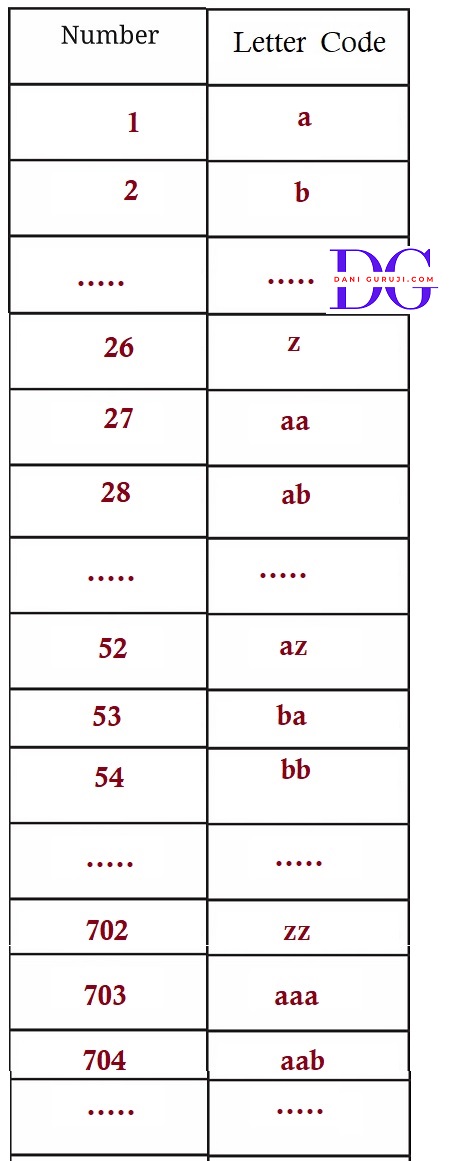
One way of extending the number system in Method 2 is by using strings with more than one letter — for example, we could use ‘aa’ for 27. How can you extend this system to represent all the numbers? There are many ways of doing it!
Solution :
This method is simply the Hindu base-10 system applied to base-26 (or any base $B \ge 2$), replacing the digits $ 1, \ldots, 9$ with the letters $\text{a}, \text{b}, \ldots, \text{z}$.
In our system, when we run out of single digits (at 9), we add a new position (the "tens" place) and start over: 10.
In this alphabet system, you run out of single digits at 'z' (26). To represent the next number (27), you add a new "place" to the left.
This new place represents groups of 26. The letter 'a' stands for 1, 'b' for 2, ..., and 'z' for 26. The numeral 'aa' means: (one × 26) + (one × 1) = 26 + 1 = 27.
To represent numbers beyond 26, use combinations of letters similar to how letters form words. For example:
Page 58
What could be the difficulties with using a number system that counts only in groups of a single particular size? How would you represent a number like 1345 in a system that counts only by 5s?
Solution :
Difficulties of Counting Only in Fixed-Size Groups
The primary difficulty with using a system that counts only in groups of a single, fixed size (like 5, without using powers of that size for subsequent places) is that it fails to be a positional system, leading to the following issues:
Inefficient Representation of Large Numbers (Non-Positional)
Arithmetic becomes harder
Representation becomes bulky
Hard for humans (and machines) to read and process
How to represent the number 1345 in a system that counts only by 5s (Base-5)
A system that “counts only by 5s” means it is base-5 (quinary system). Digits allowed: 0, 1, 2, 3, 4
We convert 1345 (base 10) → base 5.
First find the highest power of 5 smaller than 1345:
$5^{5}$ = 3125 (too big)
$5^{4}$ = 625 (too big)
1. Now, Divide 1345 ÷ 625 = 2 remainder
1345 − 2×625
= 1345 − 1250
Remainder = 95
So first digit = 2
2. Next: 95 ÷ 125 ($5^{3}$)
95 ÷ 125 = 0
Remainder = 95
Second digit = 0
3. Next: 95 ÷ 25 ($5^{2}$)
95 ÷ 25 = 3
Remainder = 95 − 75 = 20
Third digit = 3
4. Next: 20 ÷ 5 ($5^{1}$)
20 ÷ 5 = 4
Remainder = 20 − 20 = 0
fourth digit = 4
Next: remainder 0 → last digit = 0
Final answer :$$\mathbf{1345_{10} = 20340_5}$$
Page 59 Figure it out
Represent the following numbers in the Roman system.
(i) 1222 (ii) 2999 (iii) 302 (iv) 715
Solution :
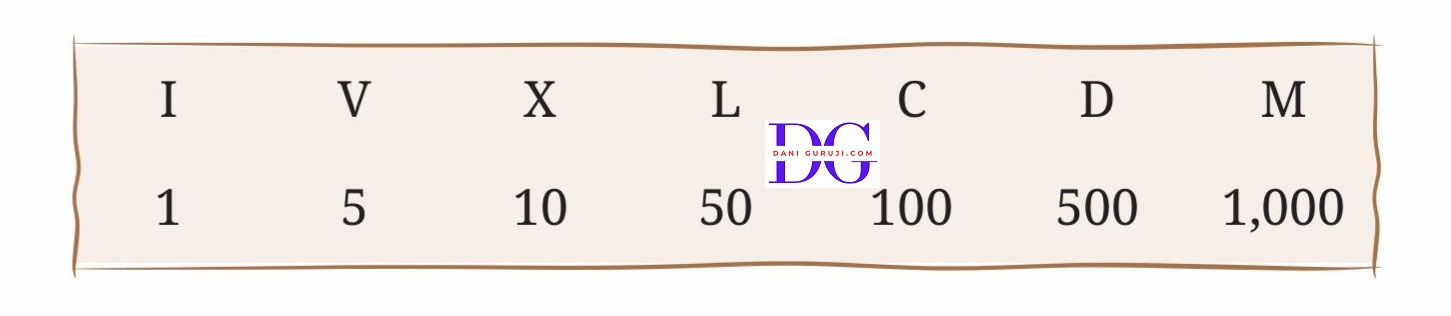
Key Roman Numerals Used
And Roman Numeral : 900 = CM (1000 - 100)
90 = XC (100 - 10)
9 = IX (10 - 1)
(i) 1222
Break it down:
$1000 + 200 + 20 + 2$
$1000 + 100 + 100 + 10 + 10 + 2$
Roman Numeral : MCCXXII
((ii) 2999
Break it down:
$2000 + 900 + 90 + 9$
$1000 + 1000 + 900 + 90 + 9$
Roman Numeral : MMCMXCIX
(iii) 302
Break it down:
$300 + 2$
$100 + 100 + 100 + 2$
Roman Numeral : CCCII
(iv) 715
Break it down:
$500 + 200 + 10 + 5$
$500 + 100 + 100 + 10 + 5$
Roman Numeral : DCCXV
Try adding the following numbers without converting them to Hindu numerals:
(a) CCXXXII + CCCCXIII
(b) LXXXVII + LXXVIII
Solution :
Key Roman Numerals Used
(a) CCXXXII + CCCCXIII
Break it down:
$$\text{CCXXXII} \quad \text{has} \quad C, C, X, X, X, I, I$$
$$\text{CCCCXIII} \quad \text{has} \quad C, C, C, C, X, I, I, I$$
Combining them (from largest to smallest value):
$$\text{C's: } C, C, C, C, C, C$$
$$\text{X's: } X, X, X, X$$
$$\text{I's: } I, I, I, I, I$$
Combined Groups
I's (Units): $I, I, I, I, I$ are five $I$'s = $\text{ V}$
X's (Tens): $X, X, X, X$ are four $X$'s = ($ X L $):
C's (Hundreds): $C, C, C, C, C, C$ are six $C$'s.
Five $C$'s are equivalent to one $D$: = ($D,C,$)
Final Result
$$\text{D C X L V}$$
The sum is DCXLV.
(b) LXXXVII + LXXVIII
Break it down:
$$\text{LXXXVII} \quad \text{has} \quad L, X, X, X, V, I, I$$
$$\text{LXXVIII} \quad \text{has} \quad L, X, X, V, I, I, I$$
Combining them (from largest to smallest value):
$$ \text{L's (50) } : L, L $$
$$\text{X's (10) } : X, X, X, X, X$$
$$\text{V's (5) } : V, V $$
$$\text{I's: (1)} : I, I, I, I, I$$
Combined Groups
I's (Units): $I, I, I, I, I$ are five $I$'s = $\text{ V}$
$V, V$ are two $ \text{V's (5) }$. Two $V$'s = $X$
$X, X, X, X, X$ are five $ \text{X's (10) }$. Five $X$'s are equivalent to one $L$
$L, L$ are two $ \text{L's (50) }$. Two $L$'s = $C$
Final Result
$$\text{C L X V}$$
The sum is C L X V.
How will you multiply two numbers given in Roman numerals, without converting them to Hindu numerals? Try to find the product of the following pairs of landmark numbers:
(i) V × L,
(ii) L × D,
(iii) V × D,
(iv) VII × IX
Solution :
Multiplying two Roman numerals without conversion is a complex task,
However, for simple landmark numbers or small composite numbers, we can use a basic symbolic method: multiplying each component and simplifying the results.
(i) V $\times$ L
$V = 5$ and $L = 50$.
$5 \times 50 = 250$
$$V \times L = \mathbf{CCL}$$
(ii) L $\times$ D
$L = 50$ and $D = 500$.
$50 \times 500 = 25,000$.
$$L \times D = \mathbf{\overline{X}\overline{X}\overline{V}}$$
(iii) V $\times$ D
$V = 5$ and $D = 500$.
$5 \times 500 = 2,500$
$$V \times D = \mathbf{MMD}$$
(iv) VII $\times$ IX
$VII = 7$ and $IX = 9$.
$7 \times 9 = 63$
$$VII \times IX = \mathbf{LXIII}$$
Page 60 to 61 Figure it out
A group of indigenous people in a Pacific island use different sequences of number names to count different objects. Why do you think they do this?
Solution :
The use of different sequences of number names to count different types of objects is a common feature of many traditional and indigenous counting systems, particularly in the Pacific islands (like Polynesian languages).
They do this because their counting systems are highly contextual and adapted to their specific cultural, economic, and practical needs.
Here are the main reasons
1. Practical Differentiation and Categorization
2. Cultural and Economic Significance
3. Linguistic and Cognitive Adaptation
4. It avoids confusion
Using different count words prevents mistakes.
Example:
If one word means “two fish tied together” and another means “two individual fish,” you avoid mixing up bundles and single items.
5. It shows sophistication, not primitiveness
Dozens (12 eggs)
Scores (20 items)
Pairs (2 shoes)
“Reams” of paper (500 sheets)
Consider the extension of the Gumulgal number system beyond 6 in the same way of counting by 2s. Come up with ways of performing the different arithmetic operations (+, –, ×, ÷) for numbers occurring in this system, without using Hindu numerals. Use this to evaluate the following:
(i)(ukasar-ukasar-ukasar-ukasar-urapon) + (ukasar-ukasar- ukasar-urapon)
(ii) (ukasar-ukasar-ukasar-ukasar-urapon) – (ukasar-ukasar- ukasar)
(iii) (ukasar-ukasar-ukasar-ukasar-urapon) × (ukasar-ukasar)
(iv) (ukasar-ukasar-ukasar-ukasar-ukasar-ukasar-ukasar-ukasar) ÷ (ukasar-ukasar)
Solution :
Let's use the simplest, most consistent interpretation: Counting is done by tallying $1$s (ukasar) until a group of $2$ (urapon) is formed.
The system must be read as: (number of $1$s) + (number of $2$s), where the $2$s take precedence.
The common structure for the Gumulgal extension is: (Base $\times$ Multiplier) + (Remainder).
In this simple structure, we assume "urapon" is a placeholder indicating a group of 2, and the preceding "ukasar" tallies the number of these groups, with the final $\text{ukasar}$ being the remainder
(i)(ukasar-ukasar-ukasar-ukasar-urapon) + (ukasar-ukasar- ukasar-urapon)
ukasar-ukasar-ukasar-ukasar-urapon = Breakdown ( $4 \times 2 + 1$ (4 groups of 2, 1 remainder)) = (Assumed Decimal Value) = 9
ukasar-ukasar-ukasar-urapon = Breakdown ( $3 \times 2 + 1$ (3 groups of 2, 1 remainder)) = (Assumed Decimal Value) = 7
$9 + 7 = 16$
(ii) (ukasar-ukasar-ukasar-ukasar-urapon) – (ukasar-ukasar- ukasar)
ukasar-ukasar-ukasar-ukasar-urapon = Breakdown ( $4 \times 2 + 1$ (4 groups of 2, 1 remainder)) = (Assumed Decimal Value) = 9
ukasar-ukasar-ukasar = Breakdown ( $1 \times 2 + 1$ (1 group of 2, 1 remainder)) = (Assumed Decimal Value) = 3
$9 - 3 = 6$
(iii) (ukasar-ukasar-ukasar-ukasar-urapon) × (ukasar-ukasar)
ukasar-ukasar-ukasar-ukasar-urapon = Breakdown ( $4 \times 2 + 1$ (4 groups of 2, 1 remainder)) = (Assumed Decimal Value) = 9
ukasar-ukasar = Breakdown ( $1 \times 2 + 0$ (1 group of 2, 0 remainder)) = (Assumed Decimal Value) = 2
$9 × 2 = 18$
(iv) (ukasar-ukasar-ukasar-ukasar-ukasar-ukasar-ukasar-ukasar) ÷ (ukasar-ukasar)
ukasar-ukasar-ukasar-ukasar-ukasar-ukasar-ukasar-ukasar = Breakdown ( $4 \times 2 + 0$ (4 groups of 2, 0 remainder)) = (Assumed Decimal Value) = 8
ukasar-ukasar = Breakdown ( $1 \times 2 + 0$ (1 group of 2, 0 remainder)) = (Assumed Decimal Value) = 2
$ 8 ÷ 2 = 4$
Identify the features of the Hindu number system that make it efficient when compared to the Roman number system.
Solution :
The Hindu Number System (originated in India) is vastly superior and more efficient than the Roman system primarily due to two foundational innovations: Positional Value and the concept of Zero.
1. Positional Value (Place-Value System)
In the Hindu system, the value of a digit depends entirely on its position within the number.
Efficiency: You only need a small, finite set of symbols (0-9) to represent any number, no matter how large. The place value is based on powers of the base (10).
2. The Concept of Zero ($\mathbf{0}$)
The invention of zero as a place-holder is arguably the most critical feature.
Clarity and Structure: Zero allows us to distinguish between numbers like 4, 40, and 400.
It signifies an empty place value. Without zero, 4 and 40 might look the same, leading to ambiguity.
3. Simple and Standardized Arithmetic
The positional system and zero enable the creation of simple, mechanical rules for arithmetic (addition, subtraction, multiplication, and division).
Standard algorithms like carrying (in addition) and borrowing (in subtraction) rely on the powers of 10 and the fixed set of digits.
These operations can be done quickly on paper using a simple look-up table for basic sums and products.
4. Notation for Fractions and Decimals
The structure naturally extends to represent values less than one.
Decimal Point: The same base-10 structure can be extended using the decimal point to represent fractions (e.g.,$0.1 = 1/10$,and $0.01 = 1/100$)
Page 62
Represent the following numbers in the Egyptian system: 10458, 1023, 2660, 784, 1111, 70707.
Solution :
Here are Egyptian numeral representations for each number, using the symbols shown in image.
(i) 10458
Let's break it down:
10000 + 100 + 100 + 100 + 100 + 10 + 10 + 10 + 10 + 10 + 1 + 1 + 1 + 1 + 1 + 1 + 1 + 1
(ii) 1023
Let's break it down:
1000 + 10 + 10 + 1 + 1 + 1
(iii) 2660
Let's break it down:
1000 + 1000 + 100 + 100 + 100 + 100 + 100 + 100 + 10 + 10 + 10 + 10 + 10 + 10
(iv) 784
Let's break it down:
100 + 100 + 100 + 100 + 100 + 100 + 100 + 10 + 10 + 10 + 10 + 10 + 10 + 10 + 10 + 1 + 1 + 1 + 1
(v) 1111
Let's break it down:
1000 + 100 + 10 + 1
(vi) 70707
Let's break it down:
10000 + 10000 + 10000 + 10000 + 10000 + 10000 + 10000 + 100 + 100 + 100 + 100 + 100 + 100 + 100 + 1 + 1 + 1 + 1 + 1 + 1 + 1





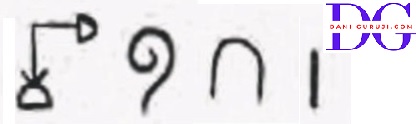

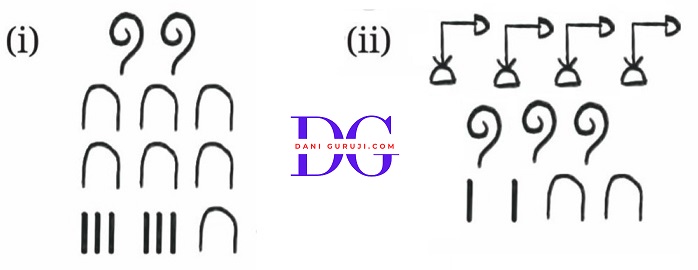
What numbers do these numerals stand for?
Solution :
(i)
(100 + 100) + ( 10 + 10 + 10 + 10 + 10 + 10 + 10 ) + ( 1 + 1 + 1 + 1 + 1 + 1)
= 200 + 70 + 6
= 276
(ii)
(1000 + 1000 + 1000 + 1000) + (100 + 100 + 100) + (10 + 10) + (1 + 1)
= 4000 + 300 + 20 + 2
= 4322
Page 63 Figure it out
Write the following numbers in the above base-5 system using the symbols in Table 2: 15, 50, 137, 293, 651.
Solution :
Here are base-5 system representations for each number, using the symbols shown in image.
(i) 15 = 5 + 5 + 5 =
(ii) 50 = 25 + 25 =
(iii) 137 = 125 + 5 + 5 + 1 + 1 =
(iv) 293 = 125 + 125 + 25 + 5 + 5 + 5 + 1 + 1 + 1 =
(v) 651 = 625 + 25 + 1 =




Is there a number that cannot be represented in our base-5 system above? Why or why not?
Solution :
No, there is no integer that cannot be represented in your Base-5 system.
The Base-5 (Quinary) system, like any other integer base system (such as Base-10 or Base-2), is a complete positional number system.
Positional Value: The Base-5 system uses the digits 0, 1, 2, 3, and 4 and assigns place values based on powers of five: $5^0$ (ones), $5^1$ (fives), $5^2$ (twenty-fives), $5^3$ (one-hundred-twenty-fives), and so on.
The Power of the Base: Because the base (5) is an integer greater than 1, and the system includes the placeholder zero, any integer, no matter how large, can be uniquely represented by finding the necessary combination of its place values.
Crucially, the system includes the symbol for zero, $\text{O}$ (Orbit). Zero is what makes the positional system work, ensuring that numbers like $4$ and $20$ are distinct.
Compute the landmark numbers of a base-7 system. In general, what are the landmark numbers of a base-n system?
Solution :
The landmark numbers of any base system are the numbers that define the place values in that system. They are the powers of the base.
In a Base-7 system, the base is $n=7$. The landmark numbers are the powers of 7, starting from $7^0$:
$7^0$ = 1
$7^1$ = 7
$7^2$ = 49
$7^3$ = 343
$7^4$ = 2,401
These landmark numbers (1, 7, 49, 343, 2401, etc.) determine the value of each digit position in a Base-7 number.
In general, the landmark numbers of a base-$n$ system are the numbers that represent the different place values.
$\text{Landmark Numbers} = n^0, n^1, n^2, n^3, n^4, \ldots$
Where: $n$ is the base of the number system.The first landmark number, $n^0$, is always 1.
Page 65 Figure it out
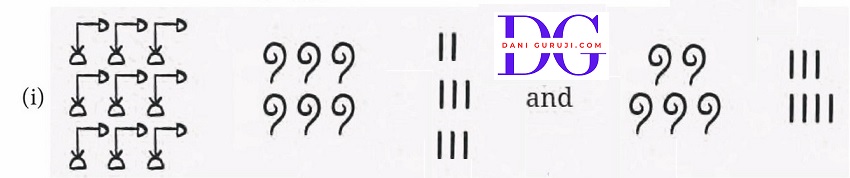
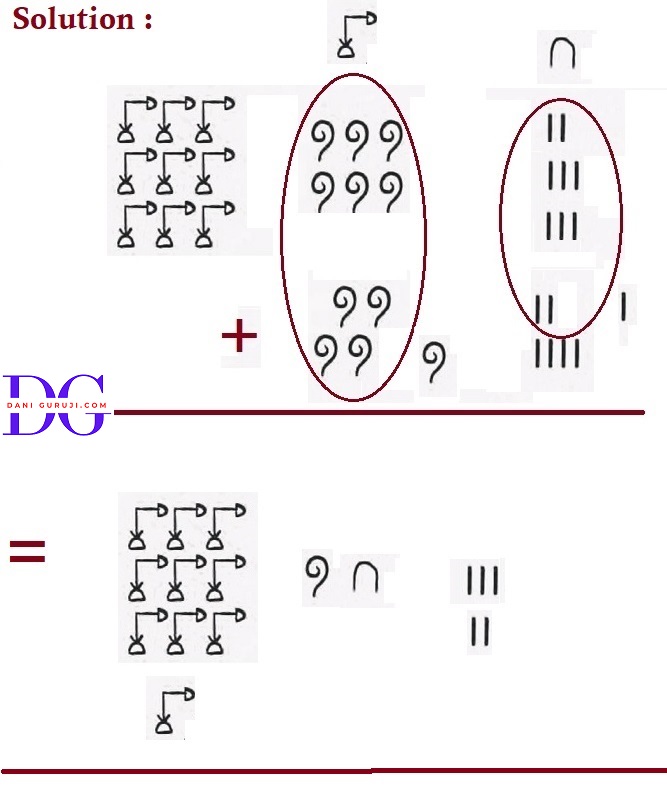
Add the following Egyptian numerals:
Solution :
Here are Egyptian numeral representations for each number, using the symbols shown in image.
(i)
(ii)
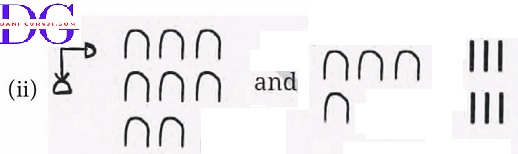
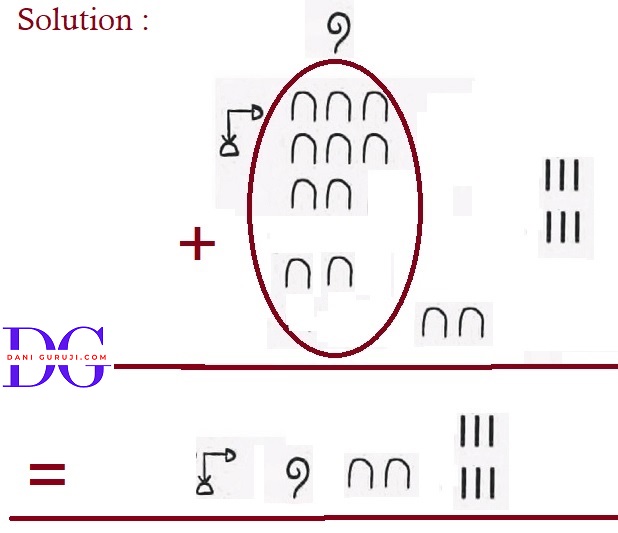
Add the following numerals that are in the base-5 system that we created:
Solution :
(i)

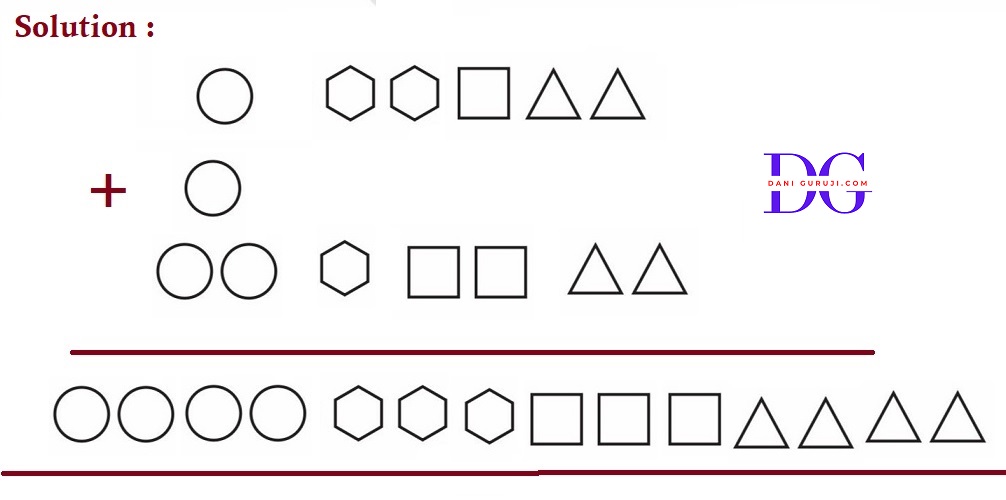
Page 66
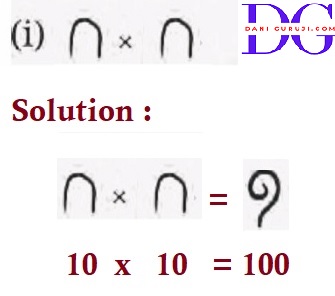
What is any landmark number multiplied by (that is 10)? Find the following products
Solution :
Here are Egyptian numeral representations for each number, using the symbols shown in image.
(i)
(ii)
(iii)
(iv)

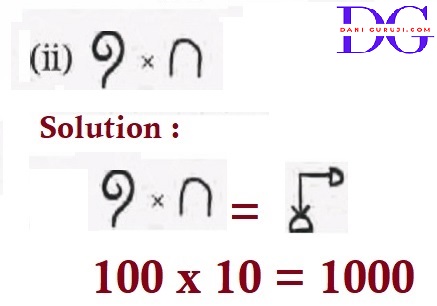
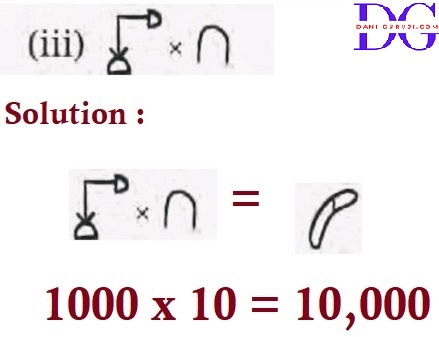
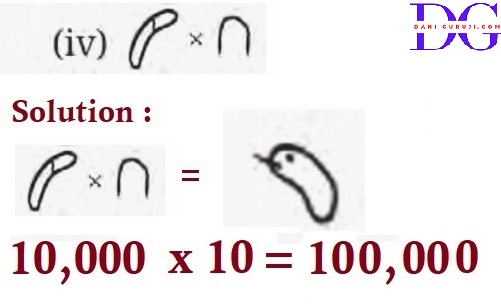
What is any landmark number multiplied by ($10^2$)? Find the following products
Solution :
(i)
(ii)
(iii)
(iv)

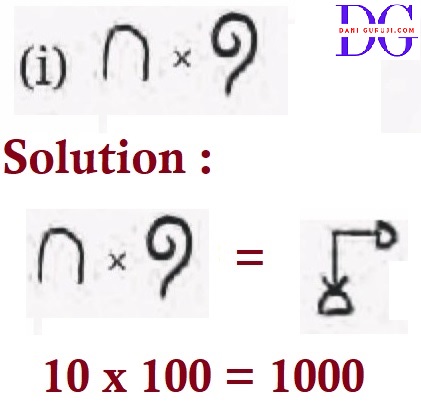
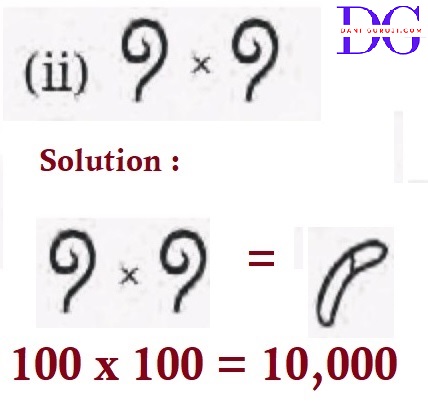
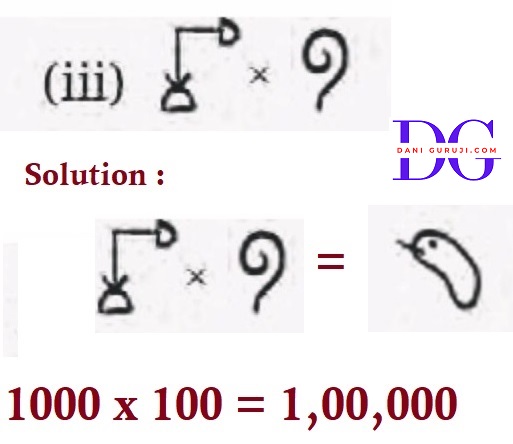
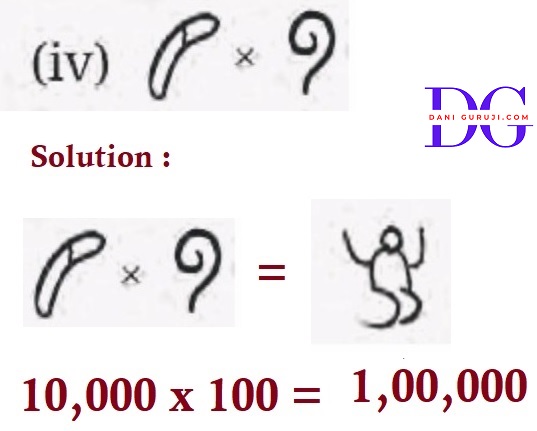
Page 67 - 68 Figure It Out
What is any landmark number multiplied by ($10^2$)? Find the following products
Solution :
(i)
(ii)
(iii)
(iv)

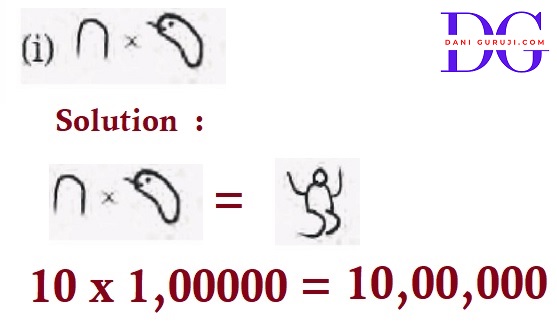
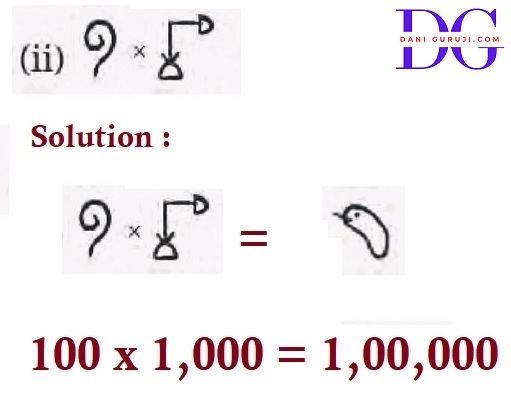
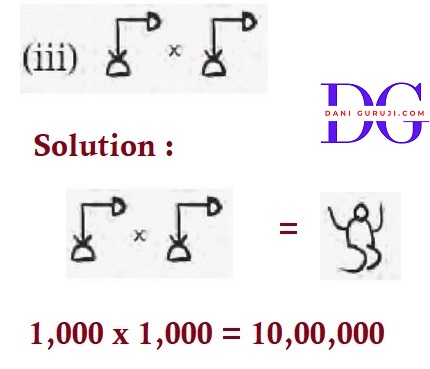
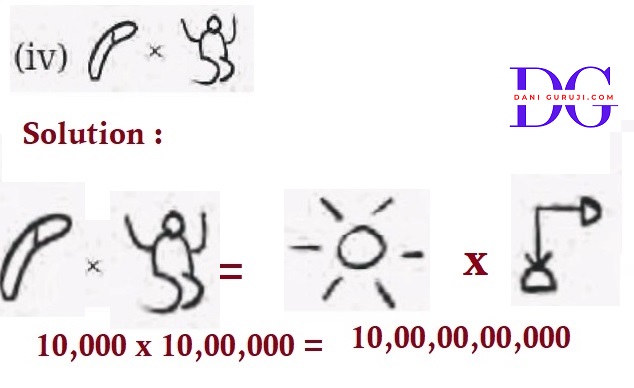
Does this property hold true in the base-5 system that we created? Does this hold for any number system with a base?
Solution :
Yes, the property that any integer can be uniquely represented holds true in the Base-5 system and holds true for any integer number system with a base $n > 1$.
This property is a fundamental characteristic of positional number systems.
Any Base-$n$ System
The efficiency and completeness of a number system depend on the following two features, both present when $n > 1$:
Positional Value: The place values are defined by powers of the base ($n^0, n^1, n^2, \ldots$). Since these powers increase indefinitely, the system can represent numbers of infinite magnitude.
Zero as a Placeholder: The set of allowed digits $\{0, 1, 2, \ldots, n-1\}$ includes zero (0).
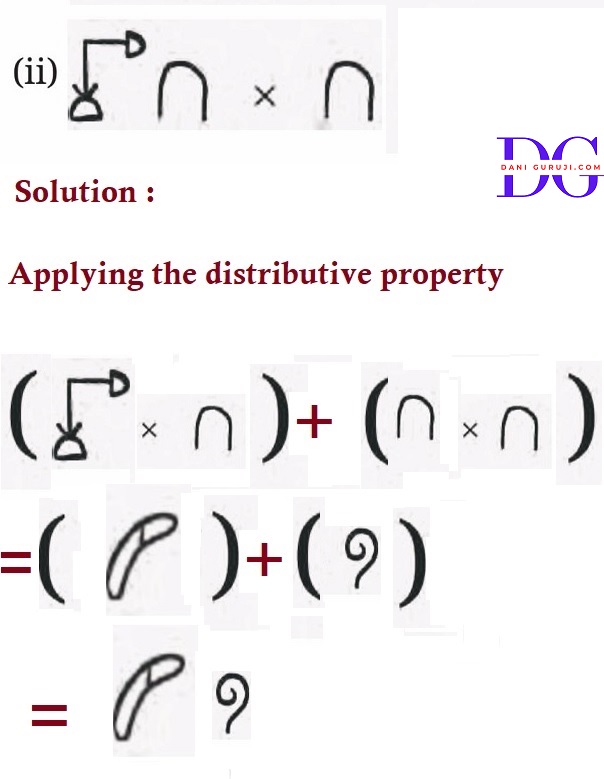
Now find the following products —
Solution :
(i)
(ii)

Page 69 - 70 Figure It Out
Can there be a number whose representation in Egyptian numerals has one of the symbols occurring 10 or more times? Why not?
Solution :
No, there cannot be a number whose representation in Ancient Egyptian numerals has any single symbol occurring 10 or more times.
This is because the Ancient Egyptian number system was additive and had a new, unique symbol for every power of ten ($1, 10, 100, 1,000$, etc.).
Reason why:
The Egyptian system used a grouping system based on ten. When representing a number, they collected groups of ten of the current symbol and immediately replaced that group with the next higher-value symbol.
If a number required a symbol to appear 10 or more times, it would mean that the representation was incomplete and could be simplified by using the next higher-value symbol.
Therefore, the representation is considered complete and correct only when the count of each symbol is a digit from 0 to 9.
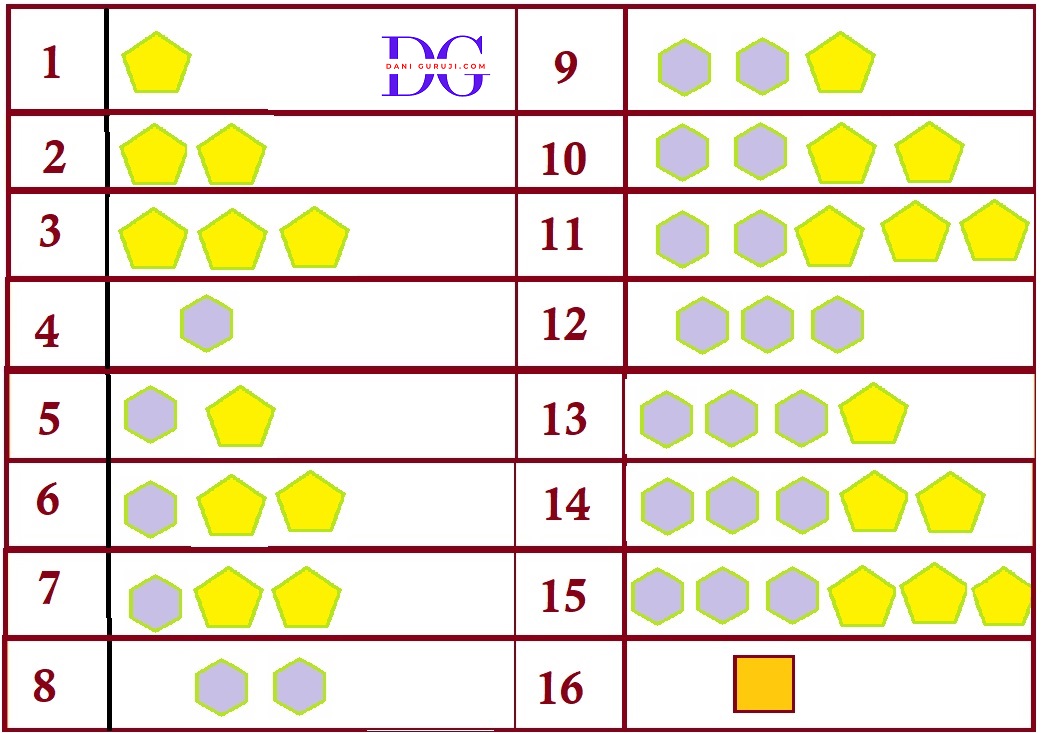
Create your own number system of base 4, and represent numbers from 1 to 16.
Solution :
To create Base 4 System our Landmark Numbers must be
$4^0 = 1$ = Pentagon
$4^1 = 4$ = Hexagon
$4^2 = 16$ = Square
Let's Invent Symbols for this :
Give a simple rule to multiply a given number by 5 in the base-5 system that we created.
Solution :
The rule for multiplying any number by its own base is very simple, and it holds true for all positional number systems (Base-$n$).
In the Base-5 system you created, the base is 5.
The Simple Rule
To multiply any Base-5 number by $5_{10}$ (which is written as $10_5$ in Base-5), you simply:
Append one zero ($\text{O}$) to the right side of the number.
Example :
Base-5 Symbol :
Decimal Value
I
1
S
2
K
3
C
4
O
0
Let's take the number 7: represented as IS in Base-5
Original Value of IS (7):
$$\text{IS}_5 = (1 \times 5^1) + (2 \times 5^0) = 5 + 2 = 7_{10}$$
Multiply by the Base (5):
$$\text{ISO}_5 = (1 \times 5^2) + (2 \times 5^1) + (0 \times 5^0)$$
$$\text{ISO}_5 = (1 \times 25) + (2 \times 5) + (0 \times 1) = 25 + 10 + 0 = 35_{10}$$
Since $7 \times 5 = 35$, the rule works perfectly: appending a zero multiplies the number by the base.
Page 73 - 76 Figure It Out
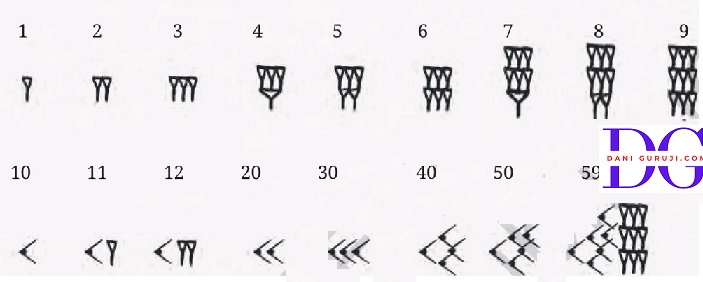
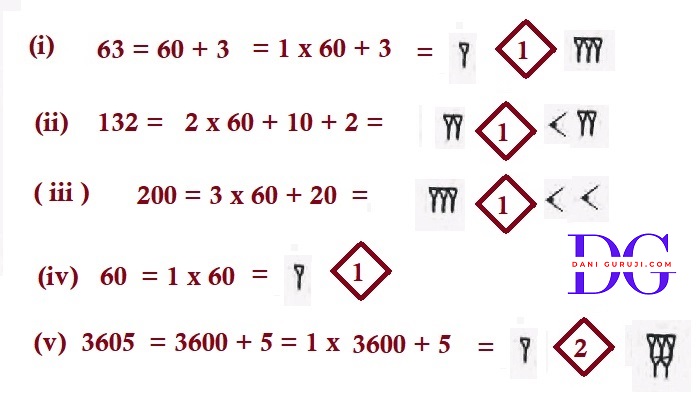
Represent the following numbers in the Mesopotamian system —
(i) 63 (ii) 132
(iii) 200 (iv) 60
(v) 3605
Solution :
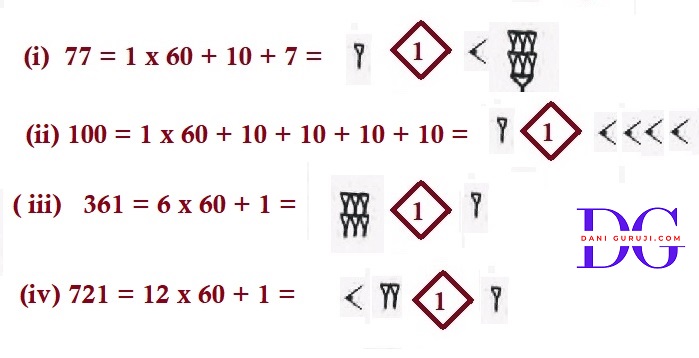
Represent the following numbers in the Mesopotamian system —
(i) 77 (ii) 100
(iii) 361 (iv) 721
Solution :
Page 80 Figure It Out
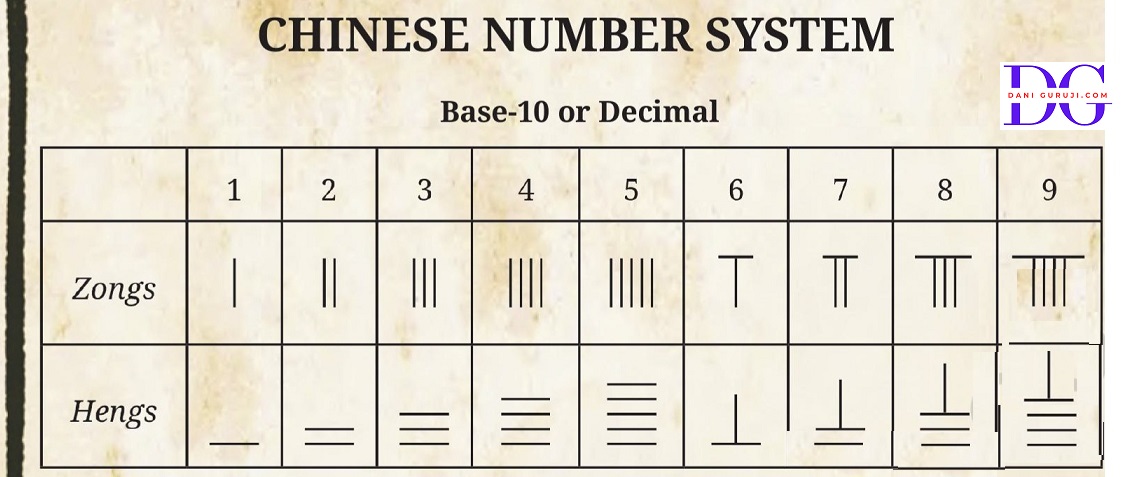
Why do you think the Chinese alternated between the Zong and Heng symbols? If only the Zong symbols were to be used, how would 41 be represented? Could this numeral be interpreted in any other way if there is no significant space between two successive positions?
Solution :
The Chinese number system used Zong (vertical) and Heng (horizontal) symbols to show place value clearly.
They alternated the direction of the symbols at each place (units, tens, hundreds, etc.) to avoid confusion when reading the number.
If only the Zong (Vertical) symbols were used, the number 41 would be represented as:$$41 = (4 \times 10) + (1 \times 1)$$
The Zong symbol for 4 is IIII, and the Zong symbol for 1 is I.
$$\text{IIII} \quad \text{I}$$
41 could be misread as 5 or even 14 if no spacing were used.
$$\text{IIIII} $$
Form a base-2 place value system using ‘ukasar’ and ‘urapon’ as the digits. Compare this system with that of the Gumulgal’s.
Solution :
The Ukasar-Urapon Positional Base-2 System.
For a true positional Base-2 (Binary) system, we need two distinct digits: 0 (zero) and 1 (one).
ukasar = 0
urapon = 1
Decimal
Base-2
Ukasar/
Urapon
Representation1
1
urapon
2
10
urapon-ukasar
3
11
urapon-urapon
4
100
urapon-ukasar-ukasar
5
101
urapon-ukasar-urapon
6
110
urapon-urapon-ukasar
7
111
urapon-urapon-urapon
8
1000
urapon-ukasar-ukasar-ukasar
9
1001
urapon-ukasar-ukasar-urapon
10
1010
urapon-ukasar-urapon-ukasar
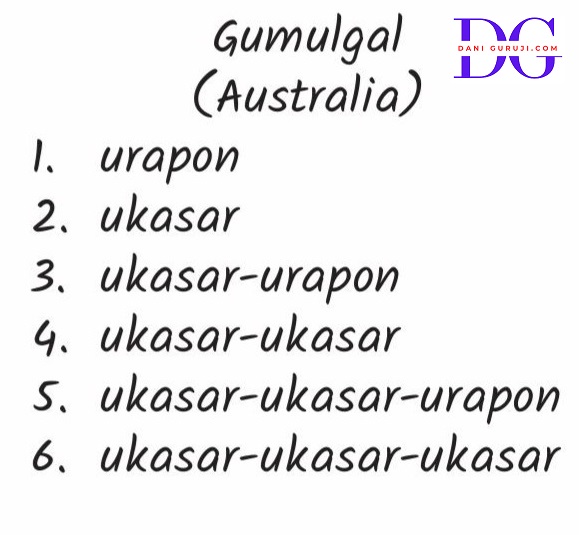
A group of indigenous people in Australia called the Gumulgal had the following words for their numbers.
In the Gumulgal System, we can name every number, but in the binary system, only the numbers shown in the table have names.
Where in your daily lives, and in which professions, do the Hindu numerals, and 0, play an important role? How might our lives have been different if our number system and 0 hadn’t been invented or conceived of?
Solution :
The Hindu number system (the positional system using the digits 0 through 9) is considered one of the most critical intellectual achievements in human history.
Its efficiency, driven by positional value and the concept of zero, underpins nearly all modern computation and organization.
If the Hindu system and the concept of zero were never conceived, our world would resemble the era of the Roman and Egyptian systems, severely limiting complexity and progress.
Where in your daily lives, and in which professions, do the Hindu numerals, and 0, play an important role? How might our lives have been different if our number system and 0 hadn’t been invented or conceived of?
Solution :
1. The Base-8 (Octal) System (If we had 8 fingers)
Digits: We would only need 8 unique digits: $\{0, 1, 2, 3, 4, 5, 6, 7\}$.
Landmark Numbers (Place Values): Powers of 8
$8^0 = 1$
$8^1 = 8$
$8^2 = 64$
$8^3 = 512$
Representing 25 (Decimal) in Base-8
To convert $25_{10}$ to Base-8, we find the largest power of 8 that fits into 25, and repeat:
Divide by $8^1$ (8): $$25 \div 8 = 3 \text{ remainder } 1$$
We have 3 groups of 8
Divide remainder (1) by $8^0$ (1): $$1 \div 1 = 1 \text{ remainder } 0$$
We have 1 group of 1
The coefficients are 3 and 1.
$$\mathbf{25_{10} = 31_8}$$
2. The Base-5 (Quinary) System (If we had 5 fingers)
Digits: We would only need 5 unique digits: $\{0, 1, 2, 3, 4\}$.
Landmark Numbers (Place Values): Powers of 5
$5^0 = 1$
$5^1 = 5$
$5^2 = 25$
$5^3 = 125$
Representing 25 (Decimal) in Base-5
To convert $25_{10}$ to Base-5, we find the largest power of 5 that fits into 25, and repeat:
Divide by $5^2$ (25): $$25 \div 25 = 1 \text{ remainder } 0$$
We have 1 group of 25
Divide remainder (0) by $5^1$ (5): $$0 \div 5 = 0 \text{ remainder } 0$$
Divide remainder (0) by $5^0$ (1):$$0 \div 1 = 0 \text{ remainder } 0$$
The coefficients are 1, 0, and 0.
$$\mathbf{25_{10} = 100_5}$$
Syllabus for class 10
Advanced courses and exam preparation.
Previous Year Paper
Advanced courses and exam preparation.
Mock Test
Explore programming, data science, and AI.